May Welsh competitions
I am not a very competitive person, but I do think that bringing in some element of a challenge is fun.
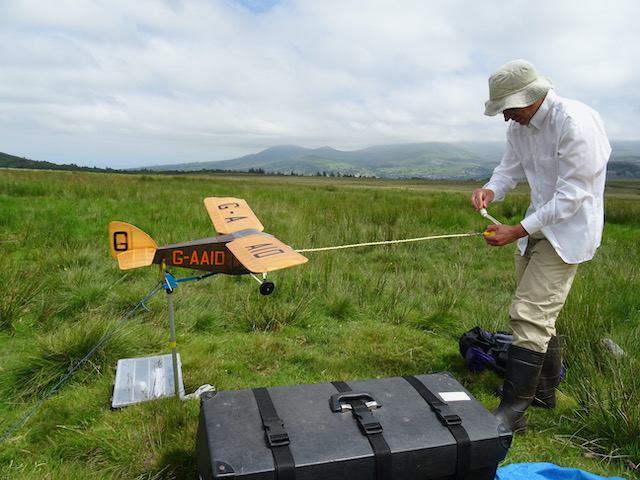
May Welsh will include some informal outdoor competitions - such as a scale precision contest (30-45 seconds) and an all-in mass launch - first one down eliminated each time until there are only two left to fight it out.
We would also like to do a scale flying only contest - with models judged for their realism in flight. This will be a little subjective of course, but it will only be for the honour, a certificate and a bottle of beer.
Derek May wants to run Mini Vintage and P30 competitions, for which the BMFA rules will be used. I include them below., verbatim.
Eligibility:3.9
Classic and Vintage Models
These models may be flown in either single discipline competitions (Vintage Glider, Classic Power etc.) or in all class competitions (Vintage or Classic)
3.9.1 A vintage model must be built in accordance with a design that was published prior to 1st January, 1951, or was kitted by that date. (January 1951 issues of magazines are accepted as published in 1950).
A classic model must be built in accordance with a design that was first published or kitted after 30th December 1950 and before 1st January 1961 (January 1961 issues of magazines are accepted as published in 1960). Designs published in the Frank Zaic 59/61 Year Book will also be admissible.
3.9.2Competitor are responsible for proving the eligibility of their models and engines to the satisfaction of the Contest Director if required, and must be prepared to produce photo-copies (or originals) of plans and magazines on the day of the contest which include or confirm the date of publication.
Guidance from the FFTC
The eligibility of the model must be based upon the existence of a plan which was published between the specified dates. The purpose of additionally specifying "kitted" is to include those plans which were supplied as part of a kit but were not "published" elsewhere.
Where multiple sizes of a design were published or kitted between the specified dates the plan must be for the actual size model entered. In the special case where a table of model sizes, including lists of material sizes referenced to a plan, was published between the specified dates this information will be sufficient and need not be accompanied by an actual size plan of the model entered.
In all these circumstances the plan, or table of sizes must be supported by photo-copies (or originals) of material which was published between the specified dates and confirms the date of publication or kitting.
Statements, publications or any other material created outside the specified dates (other than in 3.9.1 paragraph 2 above) are not acceptable as proof of either design features or publication dates.
3.9.3
Construction
Models should follow the construction shown on the plan. No major alteration should be made to structures. Minor modifications may be made as follows:
(a) Materials may be substituted, eg spruce for obechi.
(b) Balsa laminated sections may replace bent cane.
(c) Conversion from a one piece to a multi piece wing, multi piece fuselage or detachable fin and vice-versa are permissible but associated changes must not significantly change the external geometry of the model. Plywood dihedral braces and local bandaging are permissible.
(d) Local sheeting to improve handling of fuselage is allowed and also local sheeting and/or subspars on flying surfaces to take the strain of fixing bands and wing to fuselage contact.
(e) Power models may have noses altered to suit engine mounting.
(f) Minor alterations may be made to enable a D/T to be fitted to a design which was not originally so fitted.
(g) Wheels must be of the same diameter as shown on the plan but the cross section may be changed.
(h) Rubber model propeller block sizes must be adhered to, as must the type; single bladed or twin bladed; free wheeling or folding. Note: The pitch, diameter and blade width of the propeller must not be altered from that which is outlined by the propeller block size. Free wheel clutches, rubber hooks and tensioning devices may be to the competitor's choice. Propeller hubs must be of the style and material shown on the plan (eg replacement of wooden hubs with bent wire or wire hubs with machined metal etc. are not permitted). Gears are not permitted unless shown on the original plan and vice versa.
(i) Engine and D/T timers of a type not used on the original design may be used, but auto rudders and other trim-changing devices may only be used if shown on the original plans, except in the case of gliders, where an auto rudder operated by the release of the launching cable, and constructed in accordance with designs published prior to 1st January 1961 is permitted.
(j) Power models may use any type of engine and propeller, other than folding propellers, and mechanical engine brakes cannot be used.
(k) Turbulators may be added to any component of the model provided that the type of turbulator used has been described in a publication dated prior to 1st January 1951 for vintage models, or prior to 1st January 1961 for Classic models (refer to 3.9.1).
3.9.4For power models, the maximum engine run allowed from the moment of release of the model will be:
(i) For Classic models, 12 seconds.
(ii) For Vintage models 18 seconds.
3.9.5For rubber models, the maximum amount of rubber used shall be:
(i) for Classic models restricted to 75 grams (lubricated)
(ii) for Vintage models restricted to 100 grams (lubricated)
3.5.9
Mini Vintage
(a) Mini Vintage models are built in accordance with the Vintage rules under 3.9 with the following additional specifications as set out below. Otherwise they are an all class event flown in accordance with 'Mini' rules.
(b) Rubber models - The flat (ie not projected) span must not exceed 864 mm (34 inches).
(c) Gliders – The flat (ie. not projected) span must not exceed 60”.
For launching see 3.1.5.1
(d) Power models - To Vintage rules but excluding 3.9.3.(j). Models must only be powered by diesel engines of maximum capacity 0.85 cm3. Engine runs to be 20 seconds maximum.
FFTC
Clarification
Models must be built in accordance with the original design and size, subject to 3.9.3. No 'scaling' from the original size is allowed.
3.12
P.30 Rubber
3.12.1
The Model
Maximum projected span is 30 inches
Maximum length of fuselage including propeller and any release D/T wires is 30 inches
Minimum weight of model, less motor 40 grams
The model must have no timed moving surfaces apart from dethermalisers
3.12.2
The Propeller
Only a commercial plastic propeller with a maximum diameter of 9.5 inches may be used.
The hub may be modified to fit the shaft and for freewheeling purposes but not for folding.
Plastic may be removed from the surface of one blade for balancing purposes only. The diameter, pitch and blade shape may not be altered.
3.12.3
The Motor
Maximum of 10 grams (lubricated) rubber motor which must be enclosed within the fuselage.